首页Home›行Getting Around
行 · 怎么到深圳、怎么在深圳走Getting Around · Arriving in and Moving Through Shenzhen
深圳的公共交通可以说是中国大城市里最好用的之一:地铁覆盖广、票价便宜、末班车晚。真正需要提前想清楚的,是「从哪个口岸或车站进城」和「安检要排队多久」这两件事。 Shenzhen's public transport is among the easiest in urban China: broad metro coverage, low fares, late last trains. What genuinely needs advance thought is which border crossing or station you arrive through — and how long security queues can take.
抵达
到深圳的四种方式
选哪种,取决于你从哪里来。香港方向优先口岸;内地城市优先高铁;远距离国际航班走宝安机场。
1. 深圳宝安国际机场(SZX)
机场位于宝安区,是深圳唯一的民航机场。T3 航站楼与地面交通中心(GTC)一体,出关后按指示牌走即可找到地铁、机场快线、出租车与网约车。
- 地铁 11 号线(机场线):机场站在 GTC 内直达,是进市区最快也最便宜的方式,沿途经后海、车公庙、福田等主要节点。
- 机场快线大巴:在地面交通中心 17 号门旁售票柜台购票上车,覆盖福田、龙岗等 7 个城区,票价约 20–40 元。
- 出租车:全天候保障,在 13 号门外上客平台乘车。
- 网约车:实行「双通道分流」。A 区在 GTC 15 号门外,用三色车道智能导航定位车辆;B 区在 GTC 一层室内,有候车软座,输入车牌即可精准对接。
- 跨城快线:T3 航站楼二层可购买深中、深江、南沙三条跨城快线,单程约 60–80 元;长途客运站另有珠海、东莞方向班次,以及直达香港九龙等地的跨境巴士。
2. 高铁与城际铁路
深圳有多个铁路客运站,别只看「深圳」二字就下单,先确认车票上的站名。
- 深圳北站:最主要的高铁枢纽,广深港、赣深、厦深等方向列车集中,站内可直接换乘地铁 4、5、6 号线。
- 福田站:位于福田中心区地下,是广深港高铁进入市区的一站,去香港西九龙与去广州南都很方便,也是最靠近会展区的车站。
- 深圳站(罗湖):普速与部分城际列车,紧邻罗湖口岸,地铁 1 号线罗湖站直达。
- 光明城站:位于光明区,主要服务光明科学城一带。
- 西丽高铁站:随西丽综合交通枢纽建设推进,13 号线相关站点目前为越站通过状态,启用情况请以铁路与地铁官方公告为准。
从广州方向通常经广州南进深圳北或福田;从香港方向可乘高铁到福田或深圳北;从北京、上海方向则是长距离高铁,需要按整天规划。
3. 跨境口岸
从香港进入深圳,口岸比机场更常用。深圳与香港之间的陆路口岸各有性格:有的最方便,有的最晚,有的最适合自驾。
- 皇岗口岸:2026 年 10 月 12 日启用的新皇岗口岸是全球最大的陆路口岸单体建筑,提供 24 小时旅检通关,是深港之间唯一全天候开放的陆路口岸。采用「合作查验、一次放行」,官方称通关耗时可由 30 分钟压缩至 5 分钟。地铁 7 号线皇岗口岸站直达。
- 福田口岸:通关 06:30–22:30,接驳地铁 4 号线与 10 号线福田口岸站,落马洲一侧对接香港东铁线,是最常用的口岸。
- 深圳湾口岸:通关 06:30–24:00,地铁 13 号线设有深圳湾口岸站,南山区居民最方便。
- 莲塘口岸:通关 07:00–22:00,地铁 2/8 号线莲塘口岸站 A2、A3 出口步行约 5 分钟,对接香港香园围口岸,靠近上水、粉岭。
- 罗湖口岸:通关 06:30–24:00,地铁 1 号线罗湖站直连,与香港罗湖站一桥相通。
- 文锦渡口岸:通关 07:00–22:00,地铁 9 号线文锦站步行约 500 米,人流相对少。
- 西九龙高铁站:从香港市区直接乘高铁到福田或深圳北,把过关手续放在车站内完成,适合行李多的人。
4. 水上客运与自驾
- 蛇口邮轮母港:深圳最主要的水路口岸,有往返香港(含香港机场海天码头)、澳门以及珠海等方向的船班。到香港机场的航线适合「空海联运」的中转旅客。具体班次与票价请以招商蛇口邮轮母港官方渠道为准。
- 深圳机场码头:可往返澳门氹仔码头、桂山岛与东澳岛等方向。地铁 11 号线深圳机场站换乘 M590 专线,或地铁 1 号线后瑞站换乘 M419 可达。
- 水上观光:盐田至大鹏南澳等季节性航线曾限时开航,深中通道海上观光航线也在运营中,属休闲产品,班期以官方售票为准。
- 自驾与深中通道:深中通道全长 24 公里,2024 年 6 月通车,把深圳宝安到中山的车程从绕行虎门大桥的近 2 小时压缩到 30 分钟以内。与通道同步开通的深中跨市公交三条核心专线票价分别为 18 元、15 元、17 元,并提供电子月票。桥上禁止随意停车观景,疲劳驾驶风险高,长距离自驾请安排轮换。
口岸对照表
| 口岸 | 通关时间 | 接驳地铁 | 适合谁 |
|---|---|---|---|
| 皇岗口岸(新) | 24 小时 | 7 号线 皇岗口岸站 | 深夜或凌晨过关、行程不确定的人 |
| 福田口岸 | 06:30–22:30 | 4 号线、10 号线 福田口岸站 | 白天过关、要去福田中心区的商务客 |
| 罗湖口岸 | 06:30–24:00 | 1 号线 罗湖站 | 去罗湖、东门,或乘普速列车的人 |
| 深圳湾口岸 | 06:30–24:00 | 13 号线 深圳湾口岸站 | 住南山、后海、科技园的人 |
| 莲塘口岸 | 07:00–22:00 | 2/8 号线 莲塘口岸站 | 去香港上水、粉岭,或去盐田、大鹏方向 |
| 文锦渡口岸 | 07:00–22:00 | 9 号线 文锦站(步行约 500 米) | 不想排队、时间灵活的人 |
| 西九龙高铁站 | 随列车班次 | 香港侧,直达福田/深圳北 | 行李多、想一次完成过关与跨境的人 |
| 蛇口邮轮母港 | 随船班 | 2 号线、12 号线 蛇口港站一带 | 去香港机场中转、澳门或珠海方向 |
各口岸通关时间会因节假日调整,出行前请以深圳市人民政府口岸办公室与香港入境事务处的最新公告为准。
市内交通:地铁是主力
截至 2025 年 12 月 28 日新线开通后,深圳轨道交通运营线路达 18 条(含 1 条有轨电车),运营里程增至 634.5 公里,车站 441 座,实现全市各区(新区)轨道交通全覆盖,线网密度位居全国内地城市首位。
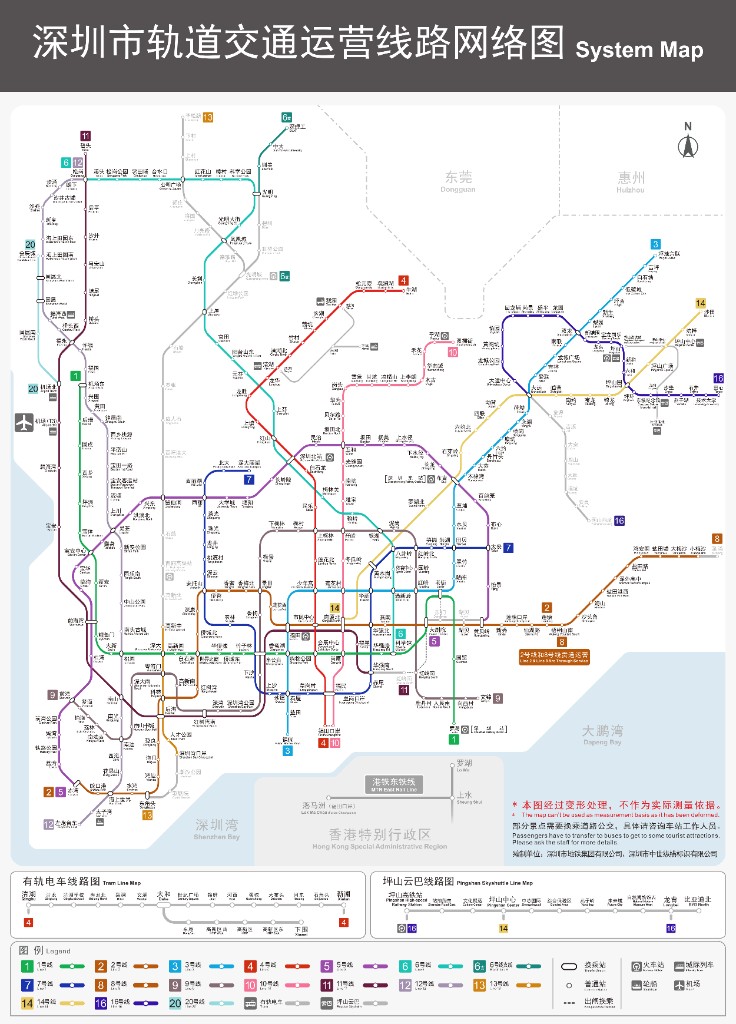
从机场与主要铁路站到各区域的通勤时间
| 起点 | 目的地 | 推荐方式 | 预计耗时 |
|---|---|---|---|
| 宝安机场 | 福田中心区 | 地铁 11 号线 | 约 45–60 分钟 |
| 宝安机场 | 南山后海 | 地铁 11 号线 | 约 25–35 分钟 |
| 宝安机场 | 罗湖 | 地铁 11 号线换 1 号线,或机场快线大巴 | 约 60–80 分钟 |
| 宝安机场 | 宝安中心 | 地铁 11 号线或 1 号线 | 约 20–30 分钟 |
| 深圳北站 | 福田中心区 | 地铁 4 号线 | 约 20–30 分钟 |
| 福田站 | 会展中心一带 | 地铁 1/2/3/11 号线或步行 | 约 5–15 分钟 |
| 罗湖站 | 福田中心区 | 地铁 1 号线 | 约 20–30 分钟 |
| 福田中心区 | 蛇口海上世界 | 地铁 2 号线 / 11 号线换 12 号线 | 约 35–50 分钟 |
| 福田中心区 | 前海 | 地铁 11 号线换 5 号线 | 约 30–45 分钟 |
| 福田中心区 | 大鹏所城/较场尾 | 地铁 2/8 号线至溪涌等站后换公交或打车 | 90 分钟以上 |
以上为正常时段的估算区间,含换乘步行时间,不含安检排队与高峰延误。请以官方 App 的实时行程规划为准。
公交与 B 字头支线
深圳公交线路编号有规律可循:E 字头多为快线巴士,多采用旅游客车规格车辆,站距长、速度快;M 字头为干线巴士,覆盖主要走廊;B 字头为支线巴士,多使用小型车辆,负责把乘客从社区送到地铁站与主干道,也就是常说的「最后一公里」。
票价一般按一票制或分段计价,通常 2 元起。用深圳通卡或乘车码同样可享受换乘优惠。公交车上下车均需刷卡/扫码,注意别漏刷。查询实时到站最方便的工具是「车来了」等实时公交小程序。
出租车
- 运价(巡游车,同城同价):起步价首 2 公里 10 元;超过 2 公里每公里 2.60 元。
- 返空费:每日 6:00–23:00,超过 25 公里部分按里程价加收 30%;超过 50 公里部分加收 60%。
- 夜间附加费:23:00 至次日 6:00,按起步价和里程价的 30% 加收。
- 其他:候时费每分钟 0.80 元;体积超过 0.2 立方米或重量超过 20 公斤的大件行李每件 0.50 元;电召服务费 2 元/次;过路、过桥、过隧费用由乘客承担。
- 发票:按《深圳经济特区出租汽车管理条例》,驾驶员应提供符合税务部门规定的发票。下车前记得索取,电子发票可扫码获取。
深圳巡游出租车已实现全城统一运价,不再按颜色区分特区内外的收费标准。深圳也是全球首个公交车与出租车 100% 纯电动化的城市,因此不会遇到燃油附加费的加收问题,但运价中的油价联动机制仍在制度上保留。
网约车
滴滴出行与高德打车是使用最广的两个入口。深圳对网约车的管理比较规范:车辆须取得网约车车辆营运证,驾驶员须持有出租汽车驾驶员证,平台须在乘客端显示车牌号、驾驶员姓名与照片、服务单位等信息。
- 机场与大型车站设有专门的网约车上车点,按指示走到对应楼层或区域再下单,比在出发层等待快得多。
- 上车前核对车牌与车型,深圳多数网约车为新能源车,车型辨识度高。
- 支付一般绑定微信或支付宝;境外手机号与境外银行卡的支持程度因平台与版本而异,建议同时准备现金或让同伴代付。
- 行程结束后可在 App 内申请电子发票,适合公务报销。
共享单车与步行
- 主流品牌:美团单车与哈啰单车覆盖最广,一般通过微信或支付宝小程序扫码解锁,按骑行时长计费。
- 停放规则:必须在划线停放区内还车,停在禁停区可能产生调度费。地铁口、商场周边的白色或黄色划线区是标准停放点。
- 能不能上地铁:不能。自行车禁止进站,已折叠且符合行李规范的折叠自行车除外。
- 骑行路线:深圳湾公园、大沙河生态长廊、人才公园一带是最受欢迎的骑行段,坡度平缓、视野开阔。注意部分绿道禁止电动车。
水上巴士与轮渡
深圳的水上客运以跨境与海岛航线为主,而不是市内通勤。蛇口邮轮母港往返香港(含香港机场海天码头)、澳门与珠海方向;深圳机场码头往返澳门氹仔及桂山岛、东澳岛。市区内的「水上巴士」并不构成日常通勤网络,出行前请直接查官方售票渠道的班期,不要按固定班次预期。
无障碍出行
- 深圳地铁全线 485 个车站已实现无障碍设施 100% 全覆盖,包括盲道、盲文与无障碍垂直电梯。
- 列车设有无障碍车厢,方便轮椅乘客固定;站台与列车之间会搭设挡板协助进出。
- 每个车站出入口设有爱心坡道,工作人员见到轮椅乘客会主动上前。
- 爱心预约:拨打客服热线 0755-88960600,或在「深圳地铁」公众号「为您服务」板块线上预约,可安排工作人员全程陪伴。
- 黄木岗交通枢纽试点启用了智能导盲犬,视障乘客可通过语音指令获得路径规划与导航引导。
第一次坐深圳地铁:五步走
-
先定路线,再买票
用高德地图、百度地图或「深圳地铁」小程序输入起终点,看清线路号、方向(往哪个终点站)与换乘站。深圳地铁站名有英文对照,认站名比记方向可靠。
-
进站过安检
所有行李须过安检机,人也要接受手持设备检查。大件行李、液体与充电宝是常见被拦的物品,充电宝单个不超过 20000mAh、最多 5 个。高峰时段请多留 10–20 分钟。
-
买票或开码
自动售票机买普通单程票(起步 2 元);或直接用微信/支付宝乘车码、深圳地铁 App、「i深圳」App、深圳通卡、银联闪付卡刷闸。要坐 11 号线商务车厢,必须另买商务车厢票。
-
上车与换乘
站台屏蔽门会显示下一班车到站时间。换乘跟着站内指示牌走,留意换乘距离——岗厦北、车公庙等枢纽的换乘步行时间不算短。
-
出闸与补费
单程票出闸时投入回收口。若超时(进闸后超过 210 分钟)或超程,需在客服中心补费。出站前确认出口编号,深圳地铁出口多、编号复杂,走错出口可能多走十分钟。
深圳地铁本身不需要实名,但中国的交通体系对实名制很认真:高铁购票与乘车必须使用有效身份证件,外国旅客用护照,港澳居民用回乡证,台湾居民用台胞证,进站与检票需人证一致;乘坐跨境船班、部分跨境巴士与口岸通关同样需要护照或通行证原件。请把证件原件随身带着,复印件与手机照片在很多场景不被接受。
另一个容易踩坑的地方是姓名拼写:在 12306 或其他平台购票时,姓名必须与证件完全一致(含空格与连字符的写法),否则可能无法取票或进站。外国护照旅客若无法使用某些线上渠道,可直接到车站售票窗口或代售点购买。
提前多久到?
- 宝安机场 国内航班建议提前 2 小时到达;无托运行李且已在线值机可压缩到 90 分钟
- 宝安机场 国际/地区航班建议提前 3 小时,出境查验与边检排队不可控
- 深圳北站 高铁建议提前 60–90 分钟;高峰期站内安检与检票口排队较长
- 福田站 高铁建议提前 45–60 分钟;站在地下,从地铁换乘到检票口需步行一段
- 福田/深圳湾口岸平峰 30 分钟,节假日高峰预留 1–1.5 小时
- 新皇岗口岸官方称采用一次放行后通关可缩短至 5 分钟量级,但开通初期与高峰仍建议留足 30 分钟以上
- 蛇口邮轮母港一般开船前 30 分钟停止检票,建议提前 1 小时到港
- 地铁赶飞机从福田中心区出发按 60 分钟估算更稳,含安检与步行
APEC 会议周:预期与应对
大型国际会议期间,会场周边通常会出现临时交通管制、道路封控与安检等级提升,地铁部分站点也可能实施客流管控或临时封闭出入口。具体措施以深圳市政府与公安机关的正式公告为准,这里不做预测。
可以提前准备的几件事:
- 会议日出门时间按「正常耗时 × 1.5 + 30 分钟」估算,宁可早到。
- 提前一天确认会场的安检要求、随身物品限制与入场证件。
- 随身带护照或通行证原件,会议证件与身份证件分开存放。
- 少依赖打车:管制期间车辆绕行会导致时间不可控,地铁+步行的确定性更高。
- 关注官方渠道:深圳市政府门户 sz.gov.cn、深圳地铁 szmc.net 与「i深圳」App。
细节与安全
儿童座椅与安全带
中国法规要求机动车驾驶人及乘车人使用安全带,儿童应在后排乘坐;出租车通常不配备儿童安全座椅,也不会因家长怀里抱孩子而免责。带幼儿出行最稳妥的做法是自带便携式安全座椅,或优先选择地铁——深圳地铁允许婴儿车进站,但会要求收起后通过安检。
炎热天气与晕车
深圳属亚热带季风气候,常年平均气温 23.0 ℃,11 月白天通常温暖、早晚偏凉,但车厢与商场空调很足,建议随身带一件薄外套。车内温度低、道路湿热容易诱发晕车,长途打车可提前开窗或要求前排座位。夏天从空调房走到户外时的温差也容易让人不适。
深夜出行
- 深圳地铁末班车多在 23:00 前后,节假日延长。深夜出行优先选择有 24 小时通关需求的皇岗口岸方向线路,或直接用网约车。
- 用 App 叫车时核对车牌与司机信息,上车后把行程分享给同伴。
- 夜间独自步行尽量走有路灯的主干道,避免穿过工地与偏僻小巷。
- 紧急情况报警电话 110,急救 120,火警 119。
行李寄存
深圳地铁已在地铁站投放自助寄存柜,覆盖范围持续扩大;机场、深圳北站等枢纽也有寄存服务与商业寄存点,按小时或按天计费,价格随时长与柜型变化。贵重物品、证件与充电宝建议随身携带,不要放入寄存柜。寄存前确认取件时间与超时计费规则。
跨境与深中出行
跨境出行请准备证件原件并检查有效期,部分口岸对行李与宠物有专门规定,宠物不能随意随人过关。深中通道方向的自驾要注意桥上禁止停车观景;跨市公交单程约 30–45 分钟,班次密集,是性价比很高的选择。节假日首日与末日车流最集中,出发前查路况。
支付与网络
地铁、公交、共享单车、便利店几乎都支持扫码支付。境外旅客建议提前绑定可用的支付方式,或准备适量现金以备万一。公共交通站内与车厢 5G/Wi-Fi 覆盖良好,但地下隧道内信号偶有波动,重要的会议邀约请提前截图保存地址与联系方式。
常见问题
从机场到市区,坐地铁还是打车?
看时间和行李。地铁 11 号线机场站在 GTC 内直达,去南山后海约 25–35 分钟,去福田中心区约 45–60 分钟,票价便宜且不受路况影响;打车的优势是门到门,但高峰期可能把 40 分钟变成 70 分钟。行李多、深夜到、或目的地不在地铁沿线时打车更合适。
深圳地铁需要实名吗?一日票划算吗?
地铁不需要实名,直接买票或刷码即可。一日票 25 元、三日票 75 元,在首次进闸后 24/72 小时内不限次数与里程。判断标准很简单:如果你一天要坐四趟以上地铁,或者当天行程横跨福田与南山、宝安,日票通常更划算;只坐两趟就买单程票。
末班车是几点?赶不上怎么办?
多数线路末班车在 23:00 前后从终点站发出,节假日与重大活动期间常延长,部分线路曾延至 24:00 甚至更晚。注意「终点站发车时间」不等于你所在站点的末班车时间,沿线站点会依次推后,务必在官方 App 查询你上车站的具体时刻。赶不上地铁就打车或网约车,深圳夜间运力充足。
深圳地铁有女性车厢吗?
目前没有。深圳曾在 2017 年起在部分线路设「女士优先车厢」,但据南方报业等媒体报道,自 2022 年 10 月新线开通起试点取消,2023 年逐步推广,站台和车厢的相关标识已撤下。现在车厢内保留的是弱冷/强冷分区与老幼病残孕专座。
地铁能带行李吗?有重量限制吗?
可以带,但有明确上限:重量 20–30 公斤或长宽高之和 1.4–1.6 米的物品需购买与普通车厢票价等额的行李票;超过 30 公斤或长宽高之和超过 1.6 米的物品禁止进站。所有行李都要过安检机。如果行李特别多,直接打车更省事。
外国人怎么买高铁票?
可通过 12306 官方渠道(网站或 App)购票,注册时使用护照信息;也可直接到车站售票窗口或代售点购买。乘车时须持购票所用的证件原件,人证一致才能进站。姓名拼写必须与护照完全一致,这一点最容易出错。港澳居民用回乡证、台湾居民用台胞证同样可以购票乘车。
从香港过来,走哪个口岸最合适?
白天去福田中心区,走福田口岸最直接(4/10 号线);深夜或凌晨过关,只有皇岗口岸 24 小时开放(7 号线);住南山、后海走深圳湾口岸(13 号线);去罗湖、东门走罗湖口岸(1 号线);去上水、粉岭或盐田、大鹏方向走莲塘口岸(2/8 号线)。行李多的话,直接把过关流程放在西九龙高铁站内完成也很省事。
共享单车能骑进公园或带上地铁吗?
不能带上地铁,自行车禁止进站,已折叠且符合行李规范的折叠自行车除外。公园方面,深圳湾公园、大沙河生态长廊等绿道非常适合骑行,但部分路段禁止电动车,也有区域要求下车推行。还车必须在划线停放区内,否则可能被收取调度费。
关于票价与运营时间:本文地铁票价结构与 15 元/36 元上限、210 分钟乘车时限、一日票 25 元与三日票 75 元、儿童优惠、行李票规则,均引自深圳地铁官网(szmc.net)的票务政策;18 条线路、634.5 公里、441 座车站为 2025 年 12 月 28 日新线开通后的官方口径;安检规则引自 2026 年 7 月起实施的进站安检全覆盖公告;无障碍服务引自深圳市残疾人联合会转述的深圳地铁信息;口岸通关时间引自深圳市人民政府口岸办公室与深圳政府在线;出租车运价引自深圳政府在线公布的巡游出租车运价标准(2017 年 5 月 5 日起同城同价);深中通道数据引自深圳政府在线 2026 年 7 月报道。
所有票价、班次与首末班车时间都会调整,重大节假日与大型活动期间尤其如此。本文只作为规划参考,出行前请通过深圳地铁官网、官方 App 或车站公告核实当日的实际时刻与票价。
Arriving
Four ways into Shenzhen
Which one you use depends on where you are coming from. From Hong Kong, a land crossing is usually best. From mainland cities, high-speed rail. Long-haul international flights land at Bao'an Airport.
1. Shenzhen Bao'an International Airport (SZX)
The airport sits in Bao'an District and is Shenzhen's only civil airport. Terminal 3 is integrated with the Ground Transportation Centre (GTC), so metro, airport coaches, taxis and ride-hailing are all signposted from arrivals.
- Metro line 11 (the Airport Line): the station is inside the GTC and is the fastest and cheapest way into the city, passing Houhai, Chegongmiao and Futian.
- Airport express coaches: tickets and boarding beside Gate 17 of the GTC, serving seven districts including Futian and Longgang, roughly RMB 20–40.
- Taxis: available around the clock from the pick-up platform outside Gate 13.
- Ride-hailing: split into two zones. Zone A is outside GTC Gate 15, with colour-coded lanes and smart navigation to locate your car; Zone B is indoors on the GTC's first floor, with soft seating — enter the plate number and meet the car precisely.
- Cross-city coaches: on the second floor of Terminal 3 you can buy tickets for the Shenzhen–Zhongshan, Shenzhen–Jiangmen and Nansha express lines, about RMB 60–80 one way. The long-distance coach station adds Zhuhai and Dongguan services, plus cross-border coaches direct to Kowloon and elsewhere in Hong Kong.
2. High-speed and intercity rail
Shenzhen has several mainline stations, so check the station name on your ticket — "Shenzhen" alone is not enough.
- Shenzhen North: the principal high-speed hub for the Guangzhou–Shenzhen–Hong Kong, Ganzhou–Shenzhen and Xiamen–Shenzhen corridors, with direct interchange to metro lines 4, 5 and 6.
- Futian Station: underground in the Futian CBD, it is where the Guangzhou–Shenzhen–Hong Kong expressway line surfaces downtown — convenient for both Hong Kong West Kowloon and Guangzhou South, and the closest station to the convention area.
- Shenzhen Railway Station (Luohu): conventional and some intercity services, right beside Luohu Checkpoint and on metro line 1.
- Guangmingcheng: in Guangming District, mainly serving the Guangming Science City area.
- Xili high-speed station: as the Xili integrated transport hub is built, the related line 13 stop currently operates as a pass-through. Check rail and metro announcements for opening dates.
From Guangzhou you normally arrive at Shenzhen North or Futian via Guangzhou South. From Hong Kong, high-speed trains reach Futian or Shenzhen North. From Beijing or Shanghai it is a long-haul rail journey that needs a full day's planning.
3. Cross-border crossings
Coming from Hong Kong, a land crossing usually beats flying. Each has its own character: the most convenient, the latest, the best for drivers.
- Huanggang Port: the rebuilt port opened on 12 October 2026 and is the largest single land port building in the world. It offers 24-hour passenger clearance — the only land crossing between Shenzhen and Hong Kong open around the clock. Its "cooperative inspection, single release" model lets one queue and one data capture complete both sides; officials say clearance drops from about 30 minutes to five. Metro line 7 stops at Huanggang Port.
- Futian Checkpoint: open 06:30–22:30, connected to metro lines 4 and 10 at Futian Checkpoint station and to the East Rail line on the Lok Ma Chau side. The most commonly used crossing.
- Shenzhen Bay Port: open 06:30–24:00, with its own metro line 13 station — easiest for Nanshan residents.
- Liantang Port: open 07:00–22:00, about five minutes' walk from exits A2 and A3 of Liantang Port station on metro lines 2 and 8. It faces Heung Yuen Wai on the Hong Kong side, close to Sheung Shui and Fanling.
- Luohu Checkpoint: open 06:30–24:00, directly linked to metro line 1 at Luohu and joined to Hong Kong's Lo Wu station by a footbridge.
- Wenjindu Port: open 07:00–22:00, about 500 m from Wenjin station on metro line 9, and usually quieter.
- West Kowloon rail station: take a high-speed train from central Hong Kong to Futian or Shenzhen North and complete immigration inside the station — ideal with heavy luggage.
4. Ferries and driving
- Shekou Cruise Homeport: Shenzhen's principal sea crossing, with sailings to Hong Kong (including the SkyPier at Hong Kong airport), Macao and Zhuhai. The airport route suits air–sea transit passengers. Check schedules and fares on the operator's official channels.
- Shenzhen Airport Ferry Terminal: serves Macao's Taipa terminal plus Guishan and Dong'ao islands. Reach it via shuttle M590 from Shenzhen Airport station on metro line 11, or M419 from Hourui on line 1.
- Scenic sailings: seasonal services such as Yantian to Nan'ao in Dapeng have operated on limited dates, and there is a sightseeing route viewing the Shenzhen–Zhongshan Link. These are leisure products — check the official ticketing channels.
- Driving and the Shenzhen–Zhongshan Link: the 24 km link opened in June 2024 and cut the Bao'an–Zhongshan drive from nearly two hours around the Humen Bridge to under 30 minutes. Three core cross-city bus routes started with the link, priced at RMB 18, 15 and 17, with electronic monthly passes. Stopping on the bridge for photos is prohibited, and fatigue is a real risk on long drives — share the driving.
Border crossing comparison
| Crossing | Opening hours | Metro connection | Best for |
|---|---|---|---|
| Huanggang Port (new) | 24 hours | Line 7, Huanggang Port | Late-night or pre-dawn crossings, uncertain schedules |
| Futian Checkpoint | 06:30–22:30 | Lines 4 and 10, Futian Checkpoint | Daytime crossings to the Futian CBD |
| Luohu Checkpoint | 06:30–24:00 | Line 1, Luohu | Luohu and Dongmen, or conventional rail departures |
| Shenzhen Bay Port | 06:30–24:00 | Line 13, Shenzhen Bay Port | Staying in Nanshan, Houhai or Science Park |
| Liantang Port | 07:00–22:00 | Lines 2/8, Liantang Port | Hong Kong's Sheung Shui and Fanling, or Yantian and Dapeng |
| Wenjindu Port | 07:00–22:00 | Line 9, Wenjin (about 500 m walk) | Avoiding queues with flexible timing |
| West Kowloon rail station | Per train schedule | Hong Kong side, direct to Futian / Shenzhen North | Heavy luggage; immigration and travel in one step |
| Shekou Cruise Homeport | Per sailing | Lines 2 and 12 near Shekou Port | Hong Kong airport transit, Macao or Zhuhai |
Crossing hours change around public holidays. Check the Shenzhen Port Office and Hong Kong Immigration Department announcements before you travel.
Getting around: the metro does the heavy lifting
After new lines opened on 28 December 2025, Shenzhen's urban rail network reached 18 lines (including one tram line), 634.5 km of route and 441 stations, covering every district and new area, with the densest network of any mainland Chinese city.
Getting from the airport and rail hubs to key areas
| From | To | Recommended | Typical time |
|---|---|---|---|
| Bao'an Airport | Futian CBD | Metro line 11 | about 45–60 min |
| Bao'an Airport | Nanshan Houhai | Metro line 11 | about 25–35 min |
| Bao'an Airport | Luohu | Metro line 11 to line 1, or airport coach | about 60–80 min |
| Bao'an Airport | Bao'an Centre | Metro line 11 or line 1 | about 20–30 min |
| Shenzhen North | Futian CBD | Metro line 4 | about 20–30 min |
| Futian Station | Convention area | Metro lines 1/2/3/11, or walk | about 5–15 min |
| Luohu Station | Futian CBD | Metro line 1 | about 20–30 min |
| Futian CBD | Shekou Sea World | Metro line 2, or line 11 to line 12 | about 35–50 min |
| Futian CBD | Qianhai | Metro line 11 to line 5 | about 30–45 min |
| Futian CBD | Dapeng Fortress / Jiaochangwei | Metro lines 2/8, then bus or taxi | over 90 min |
Estimates for normal conditions, including walking time for transfers but not security queues or peak delays. Use the official app for live journey planning.
Buses and the B-prefix feeders
Shenzhen's bus numbering follows a logic. E-prefix routes are express services, often using coach-type vehicles with long stop spacing and higher speeds. M-prefix routes are trunk services covering main corridors. B-prefix routes are feeder services using smaller buses to connect neighbourhoods to metro stations and main roads — the classic "last kilometre".
Fares are usually flat or distance-based, typically from RMB 2, and Shenzhen Tong cards or QR codes earn the same interchange discounts. Tap on and off — missing the exit tap is a common and avoidable mistake. Real-time arrivals are best checked in a live bus mini-program.
Taxis
- Fare (cruising taxis, uniform city-wide): RMB 10 for the first 2 km; RMB 2.60 per km beyond that.
- Return-empty fee: 06:00–23:00, 30% surcharge on the distance rate beyond 25 km; 60% beyond 50 km.
- Night surcharge: 23:00–06:00, 30% added to the flagfall and distance rate.
- Other: waiting time RMB 0.80 per minute; large luggage over 0.2 m³ or 20 kg costs RMB 0.50 per item; phone-booking fee RMB 2 per call; tolls, bridge and tunnel charges are paid by the passenger.
- Receipts: under the Shenzhen Special Economic Zone Taxi Management Regulations, drivers must provide a receipt compliant with tax rules. Ask before you get out; e-receipts are often available by QR code.
Cruising taxis across Shenzhen now use one unified fare, with no colour-based split between inner and outer zones. Shenzhen was also the first city in the world with a 100% electric bus and taxi fleet, so fuel surcharges do not arise in practice, although the fuel-price linkage mechanism remains on the books.
Ride-hailing
DiDi and Amap (Gaode) are the two most-used entry points. Shenzhen regulates ride-hailing closely: vehicles need an operating certificate, drivers must hold a taxi driver's licence, and the app must display the plate number, driver name and photo, and the operating company.
- The airport and major rail stations have dedicated pick-up zones. Walk to the designated floor or area and order there — much faster than waiting at departures.
- Check the plate and model before getting in. Most Shenzhen ride-hailing cars are electric and easy to identify.
- Payment is normally bound to WeChat Pay or Alipay. Support for foreign phone numbers and foreign cards varies by app and platform version, so keep a cash fallback or have a colleague pay.
- Electronic invoices are available in the app afterwards, which suits expense claims.
Shared bikes and walking
- Main operators: Meituan Bike and HelloBike have the widest coverage. Unlock by scanning in WeChat or Alipay mini-programs; charges are time-based.
- Parking rules: return bikes inside marked bays. Leaving one in a no-parking zone can trigger a relocation fee. Painted bays near metro exits and malls are the standard spots.
- Can you take a bike on the metro? No. Bicycles are not allowed in stations, except folding bikes that meet the luggage rules.
- Where to ride: Shenzhen Bay Park, the Dasha River greenway and the area around Talent Park are the most popular stretches — flat and open. Note that e-bikes are banned from some greenway sections.
Water buses and ferries
Shenzhen's water transport is about cross-border and island routes rather than commuting. Shekou Cruise Homeport runs to Hong Kong (including the airport's SkyPier), Macao and Zhuhai; the Shenzhen Airport Ferry Terminal serves Macao's Taipa plus Guishan and Dong'ao islands. There is no everyday "water bus" network within the city, so check the operator's official sales channels for actual sailings rather than assuming a timetable.
Accessible travel
- All 485 metro stations in Shenzhen have full accessibility coverage, including tactile paving, braille and step-free lifts.
- Trains have accessible carriages where wheelchairs can be secured, and staff place a boarding ramp between platform and train.
- Every station entrance has an accessible ramp, and staff actively approach wheelchair users.
- Assistance booking: call 0755-88960600 or book online under "Services for you" in the Shenzhen Metro WeChat account for staff to accompany you end to end.
- A smart guide dog pilot at Huangmugang interchange helps visually impaired passengers with route planning and navigation by voice command.
Your first Shenzhen metro ride: five steps
-
Plan the route before you pay
Enter your start and end points in Amap, Baidu Maps or the Shenzhen Metro mini-program and note the line number, the direction (which terminus it runs towards) and where you change. Station names are signposted in English — recognising the station name is more reliable than remembering a direction.
-
Pass security
All luggage goes through the X-ray machine and passengers are checked with a handheld scanner. Large bags, liquids and power banks are the usual sticking points; power banks must be 20,000 mAh or less, up to five in total. At peak, allow an extra 10–20 minutes.
-
Buy a ticket or open a QR code
Buy a standard single-journey ticket from the machines (from RMB 2), or use WeChat/Alipay transit codes, the Shenzhen Metro app, the iShenzhen app, a Shenzhen Tong card or a contactless UnionPay card. Line 11 business class requires a separate business-class ticket.
-
Board and change
Platform screens show the next train's arrival. Follow the in-station signs when changing, and note the walking distance — interchanges such as Gangxia North and Chegongmiao are not short.
-
Exit and settle any extra fare
Single tickets are collected at the exit gate. If you overrun the 210-minute limit or travel beyond your fare, settle at the service centre. Check the exit letter before you surface: Shenzhen stations have many exits, and the wrong one can add ten minutes.
The metro itself is not real-name, but China's transport system takes real-name rules seriously. High-speed rail tickets must be bought and used with a valid identity document — a passport for foreign nationals, a Home Return Permit for Hong Kong and Macao residents, a Taiwan Residents Travel Permit for Taiwanese travellers — and the person must match the document at the gate. Cross-border ferries, some cross-border coaches and all border clearance also require original documents. Carry the originals; photocopies and phone photos are refused in many situations.
Name spelling is the other common trap: on 12306 and other platforms, your name must exactly match the document, including spaces and hyphens, or you may be unable to collect the ticket or enter. Foreign passport holders who cannot use certain online channels can buy at a station ticket window or an authorised agent.
How early should you arrive?
- Bao'an Airport, domesticArrive 2 hours before departure; 90 minutes is feasible with no checked bags and online check-in
- Bao'an Airport, internationalAllow 3 hours — exit formalities and immigration queues are unpredictable
- Shenzhen North, high-speed rail60–90 minutes; station security and gate queues get long at peak
- Futian Station, high-speed rail45–60 minutes; the station is underground, so allow walking time from the metro
- Futian / Shenzhen Bay crossings30 minutes off-peak; allow 1–1.5 hours on holiday peaks
- New Huanggang PortOfficials cite single-release clearance in the five-minute range, but allow 30 minutes plus during the opening period and at peaks
- Shekou Cruise HomeportBoarding usually closes 30 minutes before sailing; arrive an hour ahead
- Metro to the airportBudget 60 minutes from the Futian CBD, including security and walking
APEC week: what to expect and how to prepare
During major international meetings, expect temporary traffic controls, road closures and higher security levels around the venue, and possible crowd control or temporary exit closures at some metro stations. Specific measures will be published by the Shenzhen municipal government and public security authorities — this page does not predict them.
What you can prepare:
- On meeting days, allow normal travel time × 1.5 plus 30 minutes.
- Confirm venue security requirements, prohibited items and credentials the day before.
- Carry your passport or travel permit original, kept separately from your event badge.
- Do not rely on taxis: diversions during controls make timing unpredictable, while metro plus walking is far more deterministic.
- Follow official channels: the Shenzhen government portal sz.gov.cn, Shenzhen Metro at szmc.net, and the iShenzhen app.
Details and safety
Child seats and seat belts
Chinese law requires drivers and passengers to wear seat belts, and children should ride in the back. Taxis generally do not carry child seats, and holding a child in your arms does not remove your responsibility. The most sensible approach with small children is to bring a portable car seat, or prefer the metro — strollers are allowed in stations but must be folded for screening.
Heat and motion sickness
Shenzhen has a subtropical monsoon climate with a year-round average of 23.0 °C. November days are usually warm with cooler mornings and evenings, but air conditioning in trains and malls is strong, so keep a light jacket with you. Cold air and humid roads can bring on motion sickness — open a window or ask for a front seat on longer taxi rides. The temperature swing when stepping from air conditioning into the street also catches people out.
Late-night travel
- Most metro lines send last trains around 23:00, extended on holidays. Late at night, prefer routes towards the 24-hour Huanggang Port, or simply take a ride-hailing car.
- Check the plate and driver details in the app, and share your trip with someone.
- Walking alone at night, keep to lit main roads and avoid construction sites and quiet lanes.
- Emergency numbers: police 110, ambulance 120, fire 119.
Left luggage
Shenzhen Metro has installed self-service lockers in stations and coverage keeps expanding; the airport, Shenzhen North and other hubs also offer staffed and commercial storage, charged by the hour or day depending on duration and locker size. Keep valuables, documents and power banks with you rather than in a locker, and confirm collection times and overtime charges before storing.
Cross-border and Shenzhen–Zhongshan travel
For cross-border trips, bring original documents and check expiry dates. Some crossings have specific rules on luggage and pets — pets cannot simply cross with their owners. If driving towards the Shenzhen–Zhongshan Link, note that stopping on the bridge for photos is prohibited; the cross-city buses take about 30–45 minutes with frequent departures and are excellent value. Traffic peaks on the first and last days of holidays, so check conditions before setting out.
Payment and connectivity
Metro, buses, shared bikes and convenience stores almost all accept QR payment. International visitors should set up a working payment method in advance, or carry some cash as a fallback. Stations and trains have good 5G and Wi-Fi coverage, though signal can dip in tunnels — screenshot important meeting addresses and contact details in advance.
Frequently asked questions
Should I take the metro or a taxi from the airport?
It depends on time and luggage. Metro line 11's airport station is inside the GTC: about 25–35 minutes to Nanshan Houhai and 45–60 minutes to the Futian CBD, cheap and immune to traffic. A taxi is door to door, but at peak a 40-minute trip can become 70. Choose a taxi with heavy luggage, late at night, or when your destination is not near a metro line.
Does the metro need real-name registration? Is a day ticket worth it?
No real-name needed — buy a ticket or scan a code. The one-day ticket is RMB 25 and the three-day ticket RMB 75, unlimited rides for 24 or 72 hours from first entry. The test is simple: if you will take four or more metro trips in a day, or cross between Futian, Nanshan and Bao'an, the day ticket usually wins. For two trips, buy singles.
When is the last train, and what if I miss it?
Most lines send last trains from their terminus around 23:00, often extended on holidays and during major events — some lines have run to midnight or later. Note that the terminus departure time is not the last train from your station: downstream stations are later, so check the exact time for your boarding station in the official app. If you miss it, taxis and ride-hailing are plentiful at night.
Does Shenzhen Metro have women-only carriages?
Not at present. Shenzhen introduced "ladies first" carriages on selected lines from 2017, but according to reports by Nanfang Media Group and others the metro began phasing them out with lines opened in October 2022, extending this through 2023, and the platform and train signage has been removed. What remains is weak/strong air-conditioning zoning and priority seats for the elderly, children, pregnant passengers and people with disabilities.
Can I bring luggage on the metro? Is there a weight limit?
Yes, within limits. Items weighing 20–30 kg, or measuring 1.4–1.6 m in combined dimensions, require a luggage ticket equal to the standard fare. Anything over 30 kg or 1.6 m is not permitted, and all bags pass through security screening. With a lot of luggage, a taxi is simply easier.
How do foreign nationals buy high-speed rail tickets?
Through the official 12306 website or app, registering with your passport details, or directly at a station ticket window or authorised agent. You must travel with the original document used for the booking — the person and the document have to match at the gate. Spelling your name exactly as in the passport is where most problems start. Hong Kong and Macao residents use the Home Return Permit, Taiwanese travellers the Taiwan Residents Travel Permit.
Coming from Hong Kong, which crossing should I use?
For the Futian CBD in daytime, Futian Checkpoint is most direct (lines 4 and 10). Late at night only Huanggang Port is open 24 hours (line 7). For Nanshan and Houhai use Shenzhen Bay Port (line 13). For Luohu and Dongmen use Luohu Checkpoint (line 1). For Sheung Shui or Fanling, or towards Yantian and Dapeng, use Liantang Port (lines 2 and 8). With heavy luggage, completing immigration inside West Kowloon rail station is also very convenient.
Can I ride a shared bike into a park or take it on the metro?
Not on the metro — bicycles are banned from stations, except folding bikes that meet the luggage rules. As for parks, the greenways at Shenzhen Bay Park and along the Dasha River are excellent for cycling, but some sections ban e-bikes and others require you to dismount and push. Bikes must be returned inside marked bays, or a relocation fee may apply.
On fares and hours: the metro fare structure with its RMB 15 and RMB 36 caps, the 210-minute limit, the RMB 25 one-day and RMB 75 three-day tickets, child discounts and luggage ticket rules all come from the ticketing policy published by Shenzhen Metro (szmc.net). The 18 lines, 634.5 km and 441 stations figures are the official position following the line openings of 28 December 2025. Security rules come from the full-screening announcement effective July 2026. Accessibility details are drawn from Shenzhen Metro information relayed by the Shenzhen Disabled Persons' Federation. Border hours come from the Shenzhen Port Office and Shenzhen government online. Taxi fares come from the cruising taxi fare standard published on the Shenzhen government portal (uniform city-wide since 5 May 2017). Shenzhen–Zhongshan Link figures come from a July 2026 report on the Shenzhen government portal.
All fares, schedules and last-train times change, especially around major holidays and large events. Treat this page as planning input only and confirm same-day times and fares through the Shenzhen Metro website, its official app or station notices.